For a limited time, you can get your own coins when you order Galilee Green Olive Oil or Raw Natural Honey! (more info below)
The lyre (כִּנּוֹר, kinnor) on the Israeli half-shekel coin (½ new shekel) is a modern depiction inspired by ancient Jewish iconography, primarily drawing from coins of the Bar Kokhba revolt era (132–135 CE).
In the Torah and Jewish tradition, the kinnor holds deep significance as a symbol of joy in divine service, prophecy, and King David’s spiritual legacy. It is not just a musical instrument but one tied to avodah (Temple worship) and the elevation of the soul.
Biblical and Traditional Background on the Kinnor
The kinnor is the first stringed instrument mentioned in the Torah:
“And it would be, when the spirit from God was upon Saul, that David would take the kinnor and play with his hand…”
The Talmud (Berakhot 3b–4a and elsewhere) expands on this with the famous story of David’s kinnor hanging above his bed. At midnight, the north wind would blow through it, awakening him for Torah study and tefillah (prayer).
“Awake, my glory; awake, nevel and kinnor; I will awaken the dawn.” (Tehillim / Psalms 57:9)
Commentaries like Yalkut Shimoni describe this as a miraculous occurrence symbolizing David’s constant devotion.
In the Temple, the kinnor (along with the larger nevel) was central to the Levitical orchestra. The Mishnah (Arakhin 2:3–6) specifies at least nine kinnorot (plural) for the daily service, with no upper limit, played to accompany the sacrifices and singing of Psalms.
Josephus (a 1st-century Jewish historian) describes the kinnor as having 10 strings, played with a plectrum or by hand.
The Image on the Coin and Ancient Coins
The depiction on the modern Israeli ½ shekel coin (and previously the 25 agorot coin) is a stylized three-stringed elongated lyre, modeled after images on Bar Kokhba revolt coins (second Jewish revolt against Rome).
These coins often show a kinnor (sometimes with 3–6 strings) as a symbol of Jewish sovereignty, Temple restoration hopes, and national identity — evoking King David’s instrument and Levitical music.
Similar lyre images appear on earlier Hasmonean-era or regional coins, like those from Acco (Ptolemais). These served as powerful emblems during times of rebellion, linking back to biblical worship.
Note on authenticity debates: Some archaeologists have questioned the exact source seal for the modern design (a debated 7th-century BCE artifact), but the iconography aligns with broader ancient Jewish coinage traditions.
In Mosaics and Archaeology
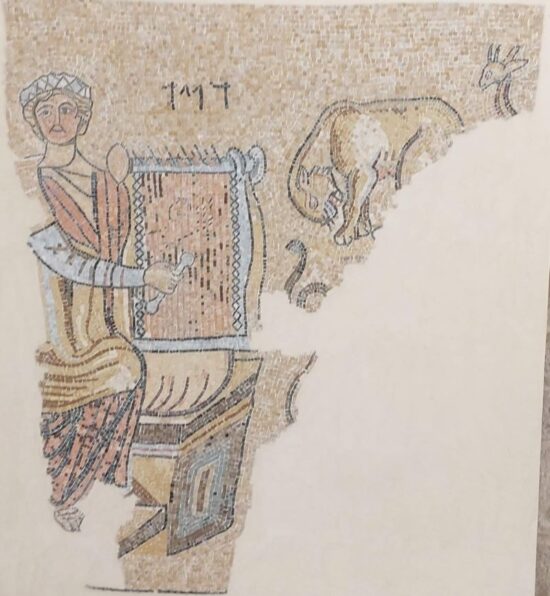
Mosaic of King David found in a Gaza Synagogue
A famous 6th-century CE mosaic from the ancient synagogue in Gaza depicts King David (labeled “דויד” in Hebrew) playing a kinnor with wild animals gathered peacefully around him — echoing the Orpheus motif but in a Jewish context of messianic harmony and David’s kingship.
Other synagogue mosaics from the Roman/Byzantine period in Israel (e.g., Huqoq, etc.) feature rich biblical scenes, though kinnor depictions are rarer than menorahs or other symbols. The instrument appears in broader ancient Near Eastern art, such as the Assyrian relief of Lachish exiles (British Museum, ~701 BCE) showing Judean captives with lyres.
These visual representations reinforce the kinnor as a symbol of Jewish resilience, worship, and Davidic lineage.
Connection to Half-Shekel and Modern Use
The half-shekel denomination itself recalls the biblical Temple tax (שקל הקודש, Shemot / Exodus 30:13–15), paid annually by every adult male Jew for communal offerings — a beautiful link between the coin’s value and its musical symbol of Temple service.
In orthodox mesorah, we view these symbols as reminders of our past glory and future redemption, when the Levites will once again play kinnorot in the rebuilt Beit HaMikdash, speedily in our days.
GET YOUR FREE HALF-SHEKEL COINS!
For a limited time, starting in June, 2026 we will be including two free half-shekel coins with your package of Galilee Green Olive Oil or Galilee Green Raw Natural Honey. Order now while supplies last!
What is the hidden message that the clouds of Elul whisper to us at the end of the summer? Summer in the Galilee is almost over. I know, because it has been cloudy this past Read more
Jacob, Esau and Italian Olive Oil Fraud Most people don’t realize that the twins, Esau and Jacob were born to become twin-leaders of the Nation of Israel. Esau was intended to be the “King” and Read more
The Freedom from physical slavery is the first exodus. Then comes freedom from psychological enslavement. Passover shows us how to break loose from our mental chains. During the 30 days leading up to Passover, it Read more



0 Comments