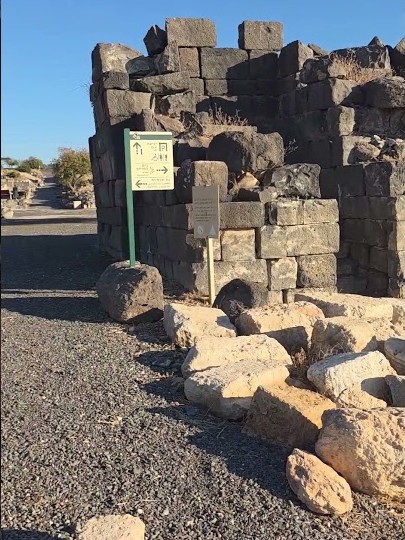
This week, Sarah Eliana and I drove around the Sea of Galilee to the eastern shore and climbed up to Sussita National Park, the ruins of the ancient city of Hippos. The city sits on a flat-topped mountain about 350 meters (1,150 feet) above Kibbutz Ein Gev, with one of the most breathtaking views of the Kinneret anywhere in Israel.
But it wasn’t only the view that took my breath away. Standing among the stone columns, I realized I was standing in the middle of the Chanukah story.
Watch: Our Visit to Sussita (Hippos)
What Was Hippos? A Greek City Above the Sea of Galilee
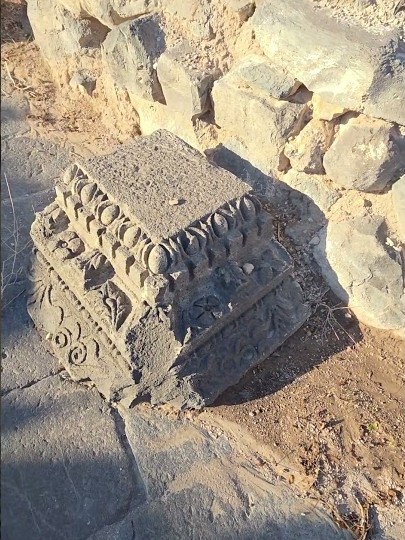
Hippos was founded in the 2nd century BCE by the Seleucid Greeks, the Syrian-Greek empire that ruled the Land of Israel after Alexander the Great. Its full name was Antiochia Hippos, named for the Seleucid kings called Antiochus.
“Hippos” means “horse” in Greek, and the Hebrew and Aramaic name, Sussita (also spelled Susita), comes from sus, the Hebrew word for horse. Even the Arabic name, Qal’at al-Husn, means “Fortress of the Horse.” Look at the mountain from the Sea of Galilee and you can see why: the ridge looks like a horse’s back.
Hippos was a typical Greek city, with a main colonnaded street, a forum, pagan temples and a theater. It was one of the cities of the Decapolis, a league of ten Greek-Roman cities on the eastern frontier.
Sussita and the Chanukah Story
The Chanukah story began with the same Seleucid Greek empire that built Hippos. King Antiochus IV tried to force the Jewish people to abandon the Torah. He outlawed Shabbat, circumcision and the study of Torah, and he defiled the Holy Temple in Jerusalem.
The Maccabees, led by Judah the Maccabee and his brothers, rose up against the mighty Greek army. With the help of the Almighty, a small band of Jews defeated the Greeks, rededicated the Temple and lit the Menorah with the one small flask of pure olive oil that burned for eight days.
But the story didn’t end there. The Hasmonean family went on to build an independent Jewish kingdom. Around 80 BCE, King Alexander Yannai, the grandson of Shimon the Hasmonean (Judah the Maccabee’s brother), conquered Hippos from the Greeks. The Greek city that looked down on the Jewish towns around the Sea of Galilee was now part of the Jewish kingdom.
Jewish independence lasted until 63 BCE, when the Roman general Pompey conquered the land and returned Hippos to Greek-Roman rule. The city later suffered a massive earthquake in the year 749 and was abandoned.
Sussita in Israel’s War of Independence
More than 2,000 years later, the horse mountain became a battlefield again.
In 1948, Kibbutz Ein Gev was the only Jewish community on the eastern shore of the Sea of Galilee, cut off and surrounded by the Syrian army on the Golan Heights above. The Syrians took Sussita and used the mountain to attack the kibbutz below. The members of Ein Gev, farmers and fishermen, held them off again and again.
Then, in July 1948, in a daring night attack, a small group of Ein Gev members together with a handful of soldiers climbed the steep ridge and drove the Syrian soldiers off the mountain.
From then until the Six-Day War in 1967, Sussita was Israel’s front-line outpost facing Syria. You can still see the old army positions and trenches next to the Greek ruins, and signs warning of minefields beside the path.
Twice in history, a small group of Jews took this mountain from a much stronger enemy. The Maccabees would have understood.
Visiting Sussita National Park
- Where: On the eastern shore of the Sea of Galilee, above Kibbutz Ein Gev. A winding road climbs from the main road near Ein Gev to the parking lot.
- The walk: A short uphill path leads from the parking lot to the ruins. Stay on the marked path: there are old minefields on both sides.
- What to see: The city gate, the colonnaded main street, the forum, the remains of the ancient city wall, and two lookouts over the Kinneret.
- Tip: Come early in the morning or late afternoon, bring water and a hat, and leave time to just sit and look at the view. Afterwards, go down to Ein Gev for fish on the shore of the lake.
- Hours and tickets: Check the Israel Nature and Parks Authority before you go.
Questions About Sussita (Hippos)
Where is Sussita National Park?
On a mountain on the eastern shore of the Sea of Galilee, directly above Kibbutz Ein Gev, about 350 meters above the lake.
What does Sussita mean?
Sussita comes from sus, the Hebrew word for horse. The Greek name, Hippos, also means horse.
Who built Hippos?
The Seleucid Greeks founded the city in the 2nd century BCE, which is why it was called Antiochia Hippos.
What does Sussita have to do with Chanukah?
Hippos was a city of the Seleucid Greek empire, the same empire the Maccabees fought in the Chanukah story. Around 80 BCE the Hasmonean king Alexander Yannai conquered it.
What happened at Sussita in 1948?
Syrian forces held the mountain and attacked Kibbutz Ein Gev below. In July 1948, Ein Gev members and soldiers captured it in a night attack, and it remained an Israeli outpost until 1967.
Bring the Light of Chanukah Home
The miracle of Chanukah was a miracle of olive oil. This year, light your Menorah and fry your latkes and sufganiyot with Galilee Green Extra Virgin Olive Oil, grown and pressed right here in the Galilee.
Order now and get a free dreidel!
With blessings from the Galilee,
R. Shmuel Veffer and Sarah Eliana
Galilee Green
Want updates like this every week? Join our weekly newsletter for news, Torah insights and recipes from the Land of Israel.


0 Comments